The Extra Board #3: Looking for the US "Micropolis" in Ottumwa, Iowa

Dear readers: My hope remains to publish this newsletter monthly. Unfortunately, despite having ample material, the speed and severity of recent events made that impossible. Eventually, I realized that all the events that I was attending—but failing to write about—were all happening in the same place (Ottumwa), so I took an opportunity to do a story that I’ve been wanting to do for a while: a profile of Ottumwa’s working-class movements, past and present, in national context. I hope you enjoy it. - JWM
We need to know a lot more about the “micropolitan” United States.
According to the US Census Bureau, a “micropolitan statistical area” or “micro” is a “county or counties (or equivalent entities) associated with at least one urban cluster of at least 10,000 but less than 50,000 population.”1
Although micros contained only 8.4 percent of the total US population in 2018, they nonetheless represented some 542 statistical areas spread across 660 counties in 47 states.2
While Vermont and New Hampshire had some of the highest percentages of micros in the nation, they were outliers in a Northeast otherwise dominated by large cities.
More representative were those micros located in the Southeast, Midwest, and West. While Texas contained the most total micro areas (46), Wyoming had the highest percentage of its population living in such areas (44.2).
At the local level, micros were more likely than the US as a whole to have a higher share of their workers in agriculture, forestry, fishing, hunting, construction and mining and manufacturing, and their total populations likewise tended to be older and whiter than average.3
Between 2000 and 2017, although many micros in the South and West grew (if not as fast as their metropolitan counterparts), those in the Midwest tended to remain stagnant or even decline in population.4
Moreover, as depopulation combined with the pressures of deindustrialization and the Right’s exploitation of media decentralization, the micros’ politics predictably shifted in turn.
Iowa is a case in point. Between 2008 and 2020, the state went from having eight of fifteen micro areas voting for Democrat Barack Obama to all fifteen casting majorities for Republican Donald Trump.
One such micro was Ottumwa, located in Wapello County, near Iowa’s southeast border with Missouri. Although the county twice voted against Ronald Reagan, including in his massive landslide victory in 1984, it has since shifted to become a reliably Republican bastion over the last decade.
But those votes hide at least as much as they reveal. Below this surface layer—the only one that most national and even many state commentators see—lies a dynamic and fundamentally working-class city that defies stereotypes.
For this reason, anyone interested in shifting Midwestern or US politics in a progressive direction needs to take these micros and their struggles seriously, and there are few places more fitting to kick off that process than Ottumwa, one of the most “micro-ish” micros of them all.
Making a Union Town, 1840s-1970s
Founded in the mid 1840s, Ottumwa initially prospered as a trading center on the edge of Iowa’s coal mining district, which stretched roughly from Des Moines to Keokuk, on the border with Missouri and Illinois. By the late nineteenth and early twentieth century, however, as the mines closed down, Ottumwa businessmen and boosters reoriented the city around the industry for which it would become synonymous for over a hundred years: meatpacking.
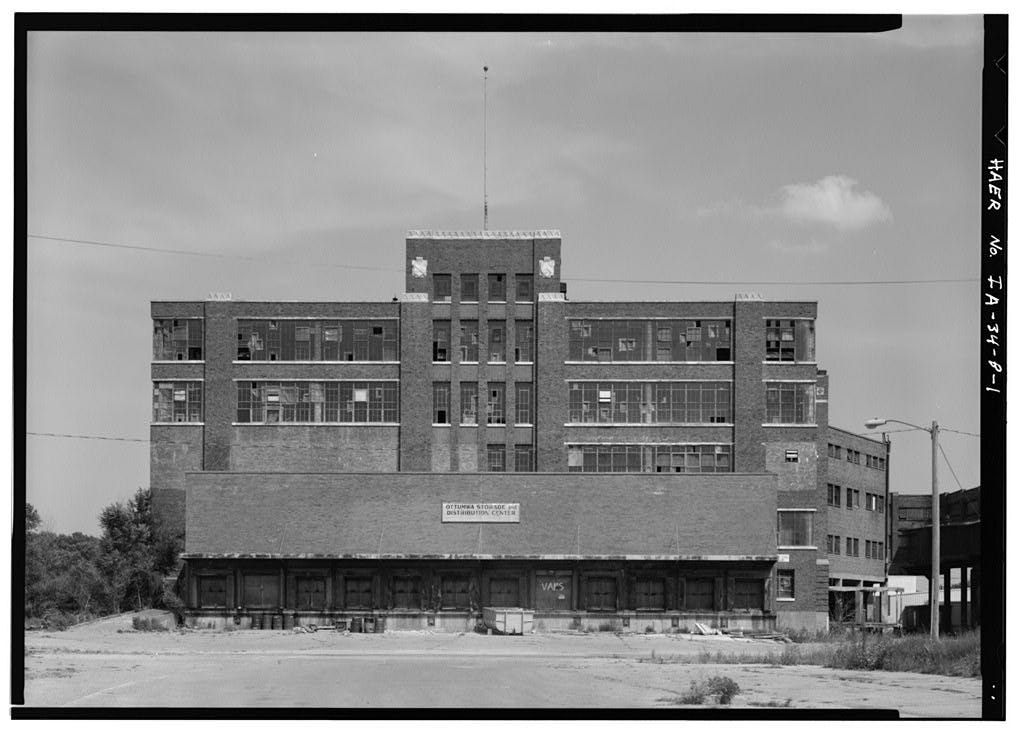
John Morrell & Company Meat Packing Plant, Building 49. Ottumwa. Photo by the Historic American Engineering Record. Library of Congress.
Between the late 1880s and the early 1970s, Ottumwa was dominated—culturally and economically—by the John Morrell meatpacking company, an enterprise founded by English businessman George Morrell, and grown and internationalized by his son, John.
Although the company certainly brought industrial jobs to Ottumwa, its vision was the extraction of profit from workers who engaged in dirty and dangerous employment overseen by managers and foremen who regarded themselves as bringing order and “civilization” to workers and their families, in and outside of the plant.5
Here’s how one of those workers, Jack McCoy, later described the “dominant attitude” of one such management family, the Fosters, during the Great Depression, and the ways in which that attitude shaped Ottumwa’s working-class consciousness:
As I was growing up in the thirties, I recall the [Foster] mansion being built at Pike Road and Elm Street. . . . When people were really desperate for food, the parties out there were in about ten acres of rose garden. Us kids would sit there on the front porch hungry. The parties out there had maybe five hundred and six hundred guests, and they’d ceremoniously break open the beer kegs with a sledge and put a dipper in the kegs. The food would get throwed out, and us kids would sneak up there and go through the damn garbage cans. The Foster family had a down-the-nose attitude toward the people of Ottumwa, [and] I guess we had a down-the-nose attitude toward them.6
By the late 1930s, those attitudes had given rise to a growing labor movement in the city. Although Ottumwa had organized workers at least as far back as the 1880s, it took several years of Depression conditions to so degrade the power of the city’s employer class that modern forms of industrial unionism could gain a foothold in the city.
By 1937, Ottumwa workers had established a local of the Independent Union of All Workers, an innovative organization, based in Austin, Minnesota, which sought to use meatpacking as a springboard to organize a broad-based workers’ movement at the community level.7
As Ottumwa labor historian Wilson Warren has written, it was also during that year that the city’s Morrell workers “received the first CIO [Congress of Industrial Organization] packinghouse union charter in the United States,” which, in 1943, earned them the distinction of becoming United Packinghouse Workers of America Local 1, “a designation members would point to proudly for years to come.”8
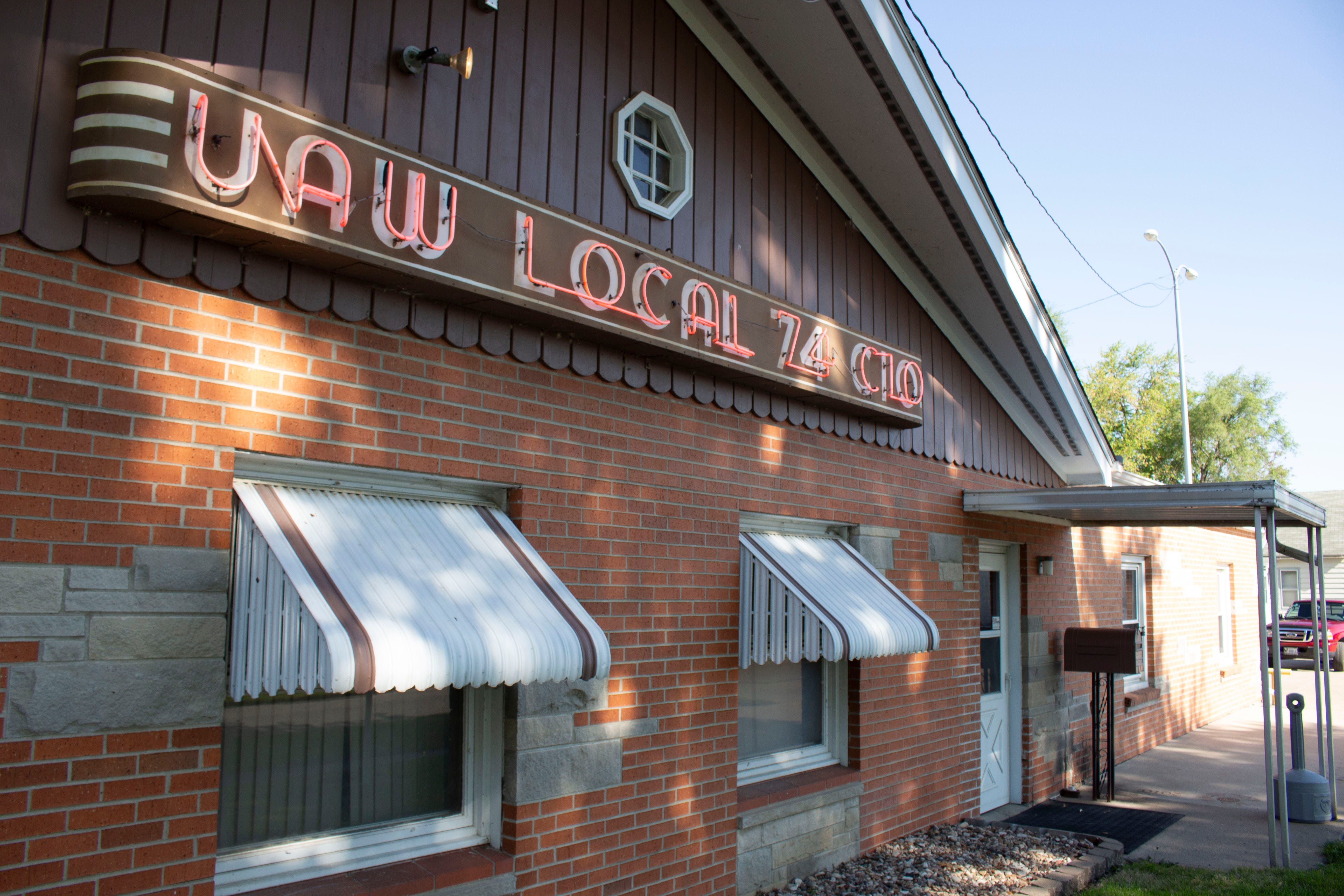
UAW Local 74’s historic union hall, a reminder of the CIO’s importance to the city’s labor movement. Ottumwa, Iowa. John McKerley.
Between the late 1940s and the 1970s, Ottumwa workers transformed this workplace-based strength into an organized political block to advance workers’ interests at the local, state, and national level, usually through the Democratic Party.
In 1949, they helped elect Democrat Hershel Loveless, a former packinghouse and railroad worker, as mayor of Ottumwa. In 1957, Loveless was able to use this local strength as the basis for a successful gubernatorial run, becoming only the fourth Democrat to win that office since the Civil War.
As Warren has written, Ottumwa workers’ support for Loveless reflected a broader pattern:
From 1932 to 1948, Democrats won 52 percent of Wapello County and Ottumwa’s gubernatorial vote. Between 1950 and 1972, Democrats garnered 58 percent of the total vote in Wapello County, and 59 percent of the vote in Ottumwa during the same period.9
In part, this loyalty came from the experience of the Democratic New Deal during the Great Depression, but it also came from labor union members running as Democratic candidates and advancing labor and working-class political issues.
These included efforts to repeal the state’s so-called “right-to-work” law; reapportioning the legislature so that representation followed the people and not property; annual salaries for legislators so that working-class people could afford to run for office without losing their jobs; improving unemployment, workers’ compensation, and occupational health and safety; and extending collective bargaining rights to the state’s public employees.10
As a result, by the early 1970s, Ottumwa was not only a town of unionized meatpacking and farm equipment workers, but a small industrial city where organizing and collective bargaining was spreading to public school teachers and city and county workers of all types. Decades of hard work had truly transformed the city into a union town.
Deindustrialization and Decline: 1970s to 2010s
Unfortunately, for all this strength and success, one thing that the movement had not achieved was the power—political or practical—to reliably and consistently stop capital flight and plant closings.11
In 1973, the Morrell Company (or, more accurately, the AMK company, which had bought Morrell in 1967, in an early wave of buy-outs, profit-stripping, and sell-offs that would come to define the next several decades) closed the plant, despite union concessions.12
The next year, the Hormel meatpacking company, based in Austin, Minnesota, demolished most of the Morrell buildings and replaced them with a new plant.
Although the Hormel plant appeared to give the city a new lease on life, a small-but-growing contingent of workers came to believe that the company’s primary goal in opening the new plant wasn’t to help Ottumwa but to undermine the powerful local union in Austin: United Food and Commercial Workers (UFCW) Local P-9.13
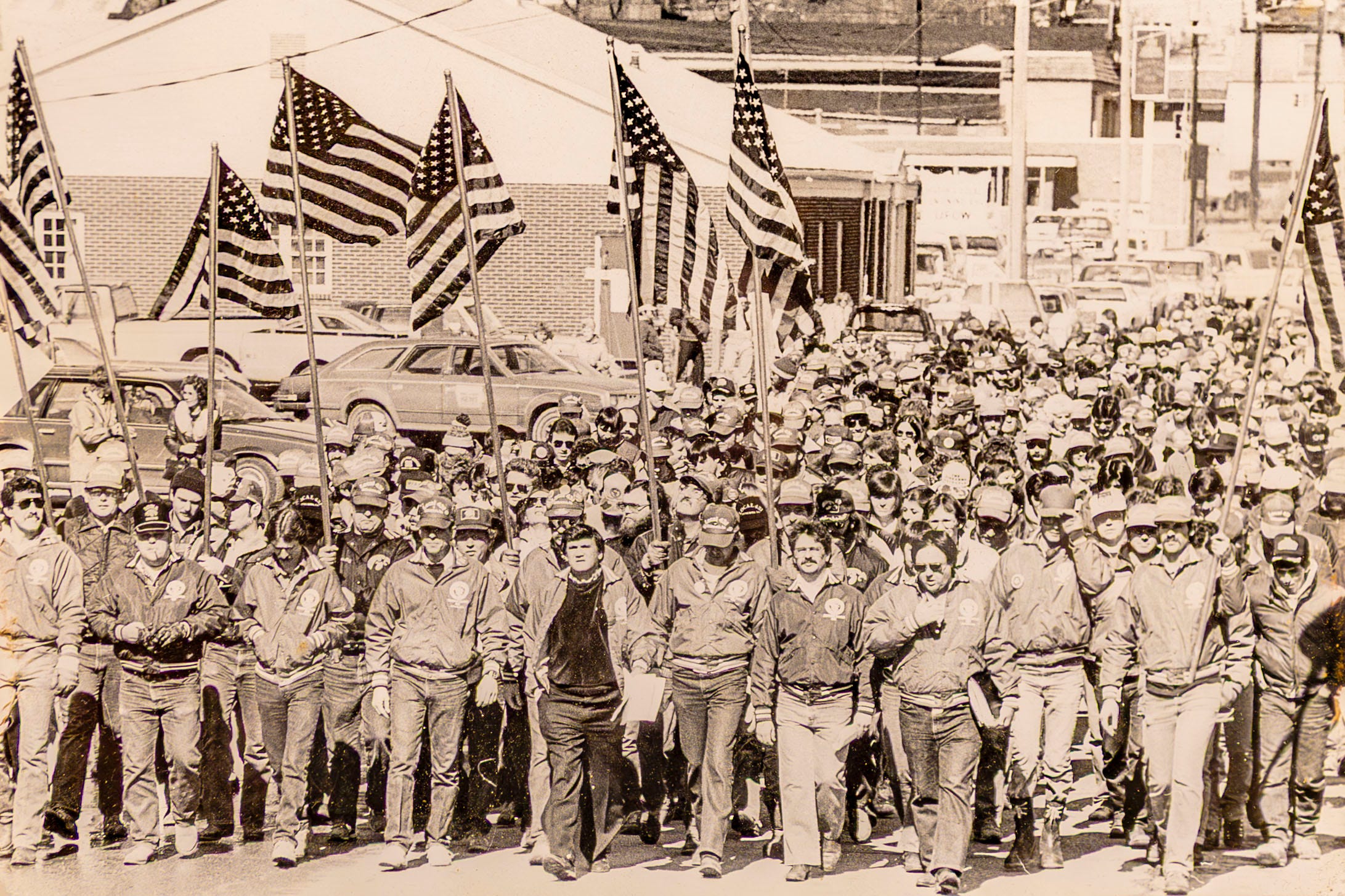
In 1985, they were confirmed in their belief when Hormel used concessions in Ottumwa (now represented by UFCW Local 431, headquartered in Davenport, Iowa) as part of an effort to put pressure on the Austin local.14
The result was a dramatic strike by Austin workers that included approximately five hundred Ottumwa workers losing their jobs for recognizing the Austin workers’ “roving” picket lines (caravans of workers who brought their pickets to other plants in the Hormel “chain” in an effort to stop production and put pressure on the company).
The Ottumwa-Hormel workers took this dramatic step for several reasons: First, they believed that it was legal under the terms of their contract (a belief that would eventually be sustained in court). Next, they were unhappy with their union leadership in Davenport, which opposed the strike. And, last, the Ottumwa and Austin locals had connections going back to the Independent-Union-of-All-Workers days during the 1930s.
Despite such acts of heroism and solidarity, however, Hormel eventually broke the strike (aided in part through the actions of Local 431’s Davenport-based leadership and the UFCW International), and, shortly thereafter, the company pulled its operations from Ottumwa.15
Detail from a plaque with inscription, “THANKS to the JOHN DEERE WORKERS from the 507 Local 431 [sic] for all your support . . . 1986.” UAW Local 74 Hall, Ottumwa. Original photographer unknown. Photo of plaque by John McKerley. 2025.
Although it wasn’t long before another meatpacking company came to town (this time, Excel), once again, the process revealed a corporate employer much more interested in extracting wealth than in providing long-term benefits to the community and its residents (even if some of its actions would have some unintended positive effects).
Following a pattern established across the region as company’s broke local unions, Excel cut wages in half from the previous standard (roughly from $10 to $5 an hour). As local workers refused to do the difficult and dangerous work for half the pay, the company turned to recruiting seasonal Latino farmworkers in the Southwest, for whom the steady pay and year-round inside work was an improvement.
Even with the new migrants, however, the sharp decline in well-paying jobs for working-class people contributed to a significant drop in population and a rise in crime, with the city becoming associated at least as much with methamphetamine as meatpacking over the course of the 1990s and 2000s.16
With this transformation also came a slow but steady shift in the way the period was remembered by local people—at least local white people—with even some union veterans of the battles of the 1980s retelling the story in a way that shifted blame for Ottumwa’s decline from the company to the new migrants, who had only arrived as fellow workers, and even then, only after the business-driven changes were already underway.
Over time, these two shifts—in material conditions and memory—combined to undermine and disorganize the old union political block. In the process, they transformed the city and its surrounding counties into a breeding ground for a politics of racism, reaction, and resentment that was already underway within the state’s Republican Party.17
This shift was noticeable as early as 2010, when two-term Democratic state senator Keith Kreiman was defeated by a bombastic anti-education and anti-immigrant Republican, Mark Chelgren. He would narrowly hang on to the seat until 2018, when he vacated in favor of a less controversial and scandal-prone Republican, Mariannette Miller-Meeks, who used the seat to set up a successful run for U.S. Congress.18
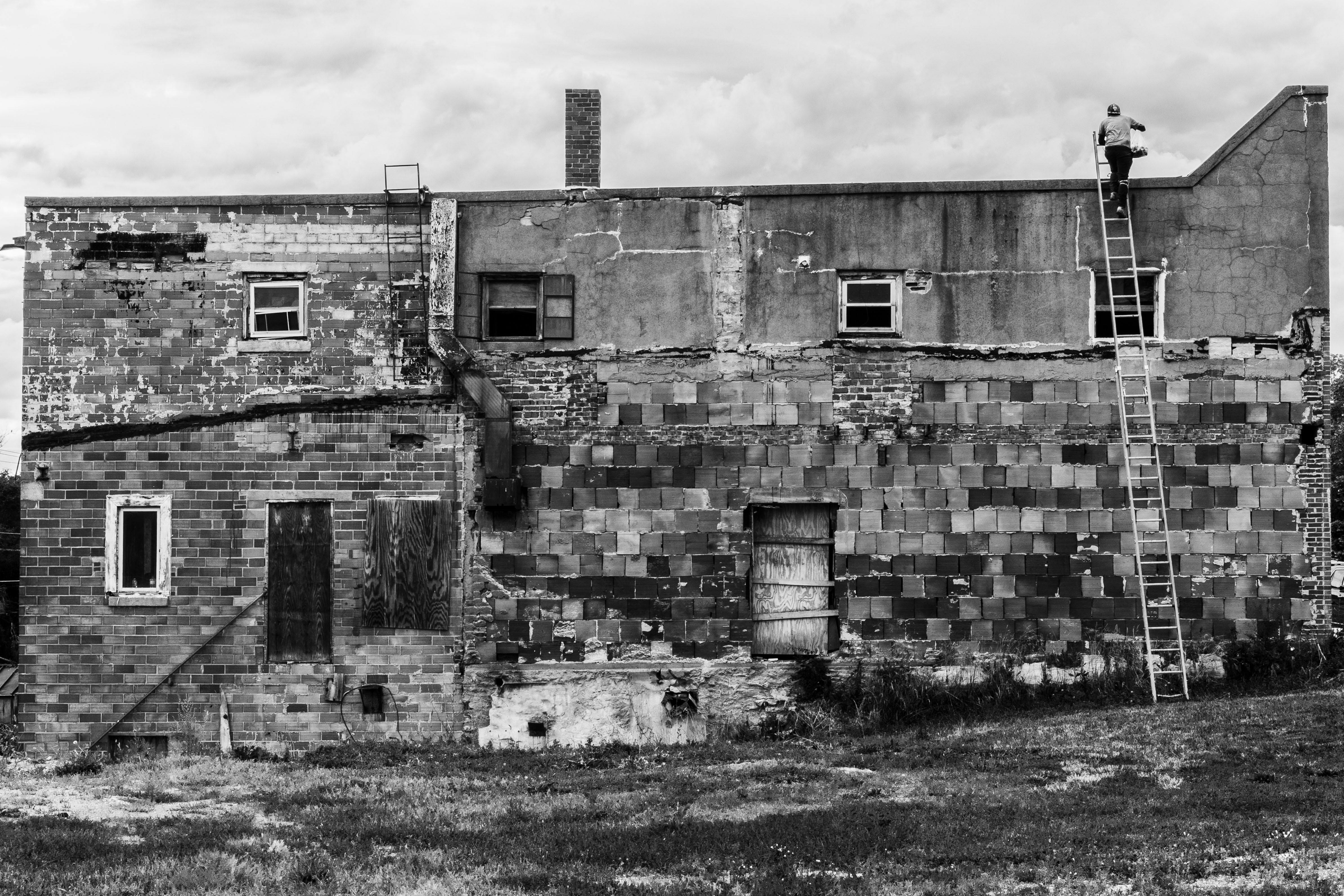
Ottumwa. 2025. John McKerley.
Revival and Rebirth? 2010-2020s
By the 2020s, for all its struggles and persistent reputation as a rough, working-class town, Ottumwa was in the midst of a mini renaissance driven by immigration (now, in many cases, in the second and third generation), state and local investment, and by dint of having been able to hold on to more of its previous “mixed” economy than many of its regional competitors.
In addition to meatpacking (now JBS) and farm equipment (John Deere) plants, it sported one of the state’s few growing micro-based school districts, the main campus of a regional community college with an international student base (Indian Hills), a regional health center, one of the state’s few true remaining small urban newspapers (the Ottumwa Courier), an Amtrak station, and numerous retail outlets, restaurants, and other small businesses.
But not all of this growth was simply business driven. After years of struggle, the city’s labor movement was back on the rise and ready to take on some hard fights. Since the Hormel strike, the city’s meatpacking workers had reorganized with UFCW Local 230, which now has a relationship with UFCW Local 1149 out of Marshalltown. In 2017, a strong local teachers’ union maintained most of its contract despite draconian changes to public-sector collective bargaining, and the city’s UAW Local 74 rallied in support of the dramatic, nationwide strike against John Deere in 2021.


Photos from the 2021 John Deere strike in Ottumwa. John McKerley.
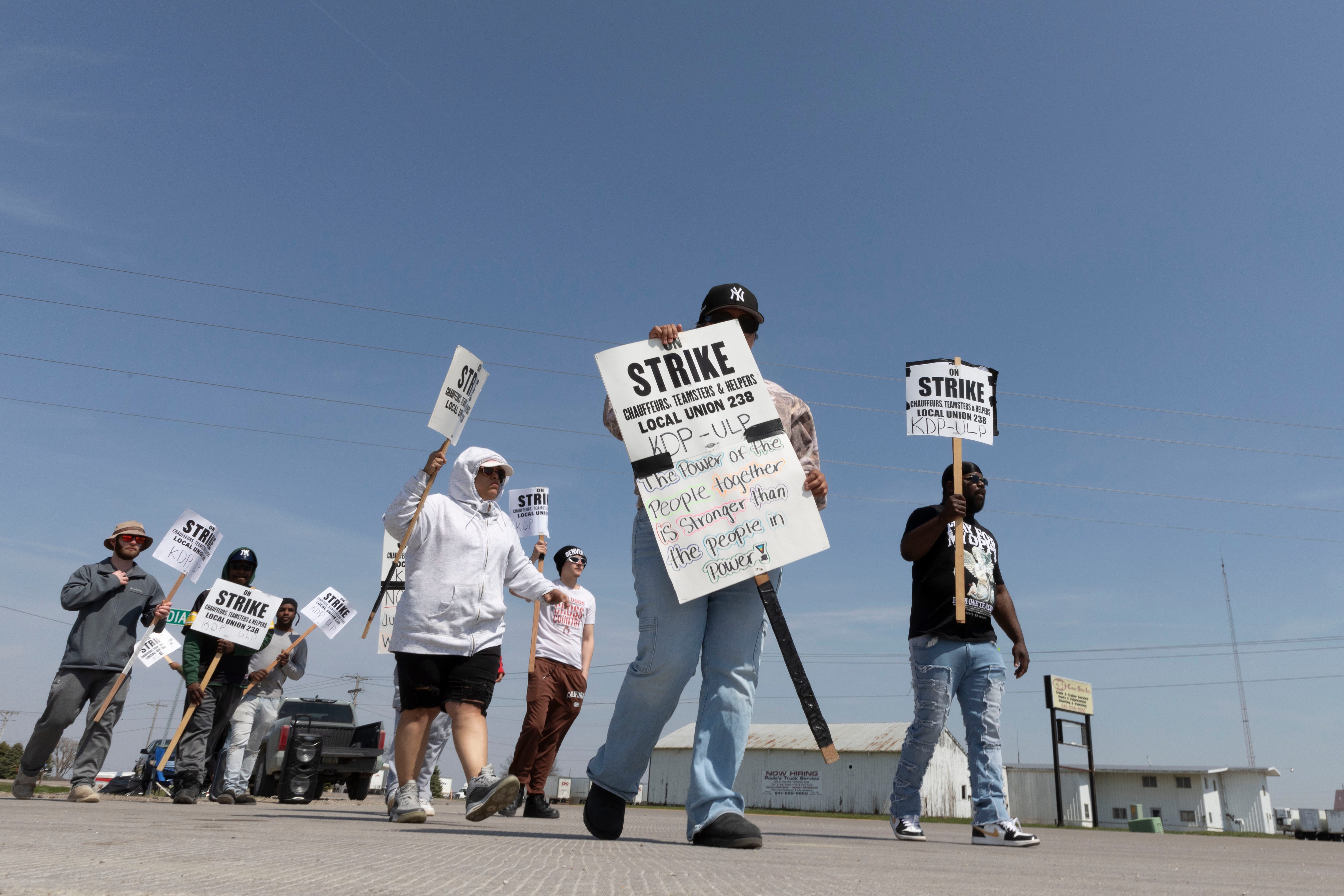
More recently, in 2024-25, faculty members at Indian Hills waged a tough but unsuccessful fight for union recognition (the first at the institution to go all the way to a vote), and, in the first part of 2025 alone, the city saw a Teamsters’ strike at Keurig Dr. Pepper; several successful actions by the local chapter of Indivisible in collaboration with state and national groups; Job Corps students, staff, and supporters coming together to defend the program from the Trump administration’s across the board cuts; and city support for PRIDE despite a nationwide anti-LGBTQ+ backlash.


Gallery of photographs from Ottumwa actions and events, Spring 2025. John McKerley.
Significant clouds still loom on the horizon: John Deere has signaled that it might attempt to close the Ottumwa plant, Republicans’ destabilization of state and federal funds threaten public employees and public services, and the city lives under constant threat of an immigration raid. But, on the whole, Ottumwa is a much more dynamic city than most people (even Iowans) recognize, and it reveals the potential for micros to be hidden engines of labor and working-class organizing and democratic renewal—if we only take the time to look.
“Micropolitan Statistical Area” as defined in Glossary, US Census Bureau, https://www.census.gov/glossary/.
“Micropolitan America,” July 2019, US Census Bureau. https://www.census.gov/content/dam/Census/library/visualizations/2019/demo/micropolitan-america.pdf.
Ibid.
Ibid.
On Ottumwa and Morrell, see Wilson J. Warren, Struggling with ‘Iowa’s Pride’: Labor Relations, Unionism, and Politics in the Rural Midwest since 1877 (Iowa City: University of Iowa Press, 2000).
McCoy as quoted in Shelton Stromquist, Solidarity and Survival: An Oral History of Iowa Labor in the Twentieth Century (Iowa City: University of Iowa Press, 1993), pp. 54-55.
Regarding the IUAW, see Peter Rachleff, “Organizing ‘Wall to Wall’: The Independent Union of All Workers, 1933-37,” in “We Are All Leaders”: The Alternative Unionism of the Early 1930s, edited by Staughton Lynd (Urbana: University of Illinois Press, 1996), pp. 51-71.
Warren, “When ‘Ottumwa Went to the Dogs’: The Erosion of Morrell-Ottumwa’s Militant Unionism, 1954-1973,” Annals of Iowa 54 (Summer 1995): 217-43.
Warren, Struggling, 86.
Regarding labor’s political issues and relationship to the Iowa Democratic Party during this period, see Stromquist, Solidarity, esp. pp. 288-294.
US workers, including in Iowa, attempted to use a variety of innovative methods to stop plant closings during these years. For an Iowa meatpacking example, see Gene Redmon, Chuck Mueller, and Gene Daniels, “A Lost Dream: Worker Control at Rath Packing,” Labor Research Review 1, 6 (1985): https://core.ac.uk/download/pdf/5116977.pdf. Regarding what is perhaps the most famous example in the Pittsburgh-Youngstown steel region, see Mike Stout, Homestead Steel Mill: The Final Ten Years—USWA Local 1397 and the Fight for Union Democracy (Oakland, Cal.: PM Press, 2020).
Warren, Struggling, 117-118.
Like Ottumwa’s pre-1973 union, UFCW P-9 had once been part of the militant United Packinghouse Workers, signified by the “P” before the local number.
Local 431 had been an affiliate of the Amalgamated Meat Cutters and Butcher Workmen of North America, not the United Packinghouse Workers, thus no “P.” In 1968, the UPWA had become part of the Amalgamated, which later merged with the Retail Clerks union to form the United Food and Commercial Workers.
For an overview of the strike, see Peter Rachleff, Hard-Pressed in the Heartland: The Hormel Strike and the Future of the Labor Movement (South End Press, 1999).
For an example of high-profile storytelling about crime in Ottumwa, see Nick Reding, Methland: The Death and Life of an American Small Town 2009 (Bloomsbury: New York, 2010), especially chapter 3,
Regarding deindustrialization, the farm crisis, and long rise of the right in the region, see Osha Gray Davidson, Broken Heartland: The Rise of America’s Ghetto 1990 (Iowa City: University of Iowa Press, 1996), esp. chapter 6.
See entries for Kreiman, Chelgren, and Miller-Meeks in Iowa Legislators Past and Present, https://www.legis.iowa.gov/legislators/informationOnLegislators/historicalInformation.